

Museum
Museum and Visitors Center Hours:
Tuesday-Friday: 9:00 A.M. to 4:00 P.M. (Closed on Mondays)
Call (620) 947-3775 for an appointment or stop by during business hours.
Donations accepted for tours.
COMING SOON:
THE BARTEL HOUSE
A Privately Funded Masonry Project
In 1879, Heinrich F. Bartel built what is now considered one of the earliest stone structures in Marion County and one of the last remaining Mennonite Polish/Eastern European-style houses still in existence in the United States.
Escaping economic and political hardship in the Warsaw District of Central Poland, Bartel arrived at the Peabody railroad depot in the spring of 1876 as part of a wave of European Mennonites settling in Central Kansas.
While living in a small dugout shelter built into the side of a hill approximately 1.5 miles north of the village of Hillsboro, Bartel decided to construct a better home for his growing family.
Using two teams of horses and brute strength, Bartel hauled two full wagonloads of limestone each day, often working at night by light of a kerosene lantern. It’s unclear how long construction took, and family records cannot confirm whether Bartel began or completed the house in 1879.
The house featured three bedrooms on both the upper and lower floors, a kitchen, and a small fruit cellar. Its limestone walls retained heat in the winter, while upper-level gables let in a south breeze during the summer.
Following his death at age 54, Bartel’s surviving relatives and future descendants continued living in the house until 1959, when termite damage rendered the structure unsafe for occupancy.
Today, the Bartel House is carefully being relocated to the Hillsboro Museum grounds, where it will be restored and interpreted for future generations as a lasting reminder of the resilience, craftsmanship, and heritage of Marion County’s early Mennonite settlers.
We’d like to pay special recognition to our contractor, Spring Branch Construction LLC, for the skill, care, and professionalism invested in this project. We’d also like to thank our sponsors, the City of Hillsboro and Hillsboro Community Foundation, for their generous financial support and shared commitment to preserving our community’s heritage.
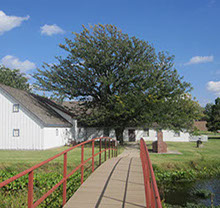
Pioneer Adobe House
S. Memorial Dr. and West D St.
The Peter Paul Loewen family, Mennonite immigrants from Russia, built the Pioneer Adobe House in 1876 from air-dried adobe bricks. It was moved to town in 1958 and is furnished with articles used by early Mennonite settlers.
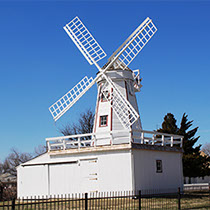
Friesen Dutch Windmill
Adobe House Complex
Jacob Friesen built the original gristmill in Gnadenau village in 1876, which was located several miles south of Hillsboro. Dr. Richard Wall built this replica in 1994 using original materials and construction methods.
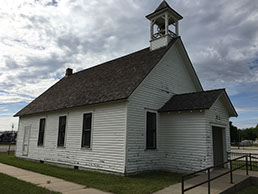
Kreutziger School House
Adobe House Complex
The Kreutziger one-room school house started in 1886 and operated until 1960. When the waters of Marion Reservoir threatened to flood it, it was moved into town. It is furnished as an 1890’s-era school house.
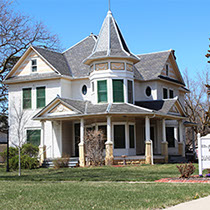
Schaeffler House
Grand Ave. and Jefferson St.
The Schaeffler House is reflective of a prosperous Midwestern family in the early years of the century. This home of Lutheran immigrants from Germany was constructed in 1909.